Extreme Local Search Optimization Tactics
I make it a point to follow blogs and conference sessions to see what everyone recommends for “Local Search Optimization”, and I have to say that most of it’s repetitive and too limited. Most folx who write about this subject have said little more than “put a business’s address and phone number on all their site’s pages”, and “update/enhance the business’s information in all the major directory sites”. A lot of the focus is on search marketing, and very little has been outlined for optimizing for local search beyond all the aspects of traditional natural search optimization.
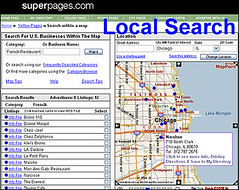
Similarly, I previously wrote on the subject and just added a marginally unique spin by suggesting that local biz sites should follow the hCard Microformat when adding the address and contact info to their site’s pages. Yet, I think all of us who work in local SEO have not really pushed the envelope much with these limited suggestions, and we haven’t really outlined a lot of the other areas where savvy webmasters and businesses could make themselves even more optimal for the local search paradigm. Local Search is a unique beast, and in many ways is more complex than pure keyword search, so why hasn’t anyone addressed some of the unique aspects that could really drive a local business’s online referrals higher via optimizations?
So, I’m pulling out the stops and posting some strategies here that could inch a local business past its competition. Some of these tips are not for the faint-of-heart, and may assume that you might change some things about your business that are traditionally things that people don’t consider changing just to improve referrals from online search. Read on and I’ll give you an insider’s tips for some extreme local optimizations!
First of all, most businesses do not consider using valuable keywords when they come up with a business name. They focus on creating a unique name and creating a brand that will catch people’s attention or convey something about the product or service. Unfortunately, more frequently than not, a business’s name rarely contains keywords that users type into search engines when trying to find their type of business.
Tip # 1: Change your business name to include a few of the top keywords that users type into search engines when seeking your type of business in your area.
For instance, a plastic fabrication company in Seattle might be formally named “Xerxes Tech Industries”. They could potentially get more online referrals if they were named something like “Xerxes Tech Industries Plastics Factory of Seattle”. I’m not saying that they should refile for new business licenses or get all new letters of incorporation — but they could informally change their name on their website and in all the major online directories. Longtime customers could still locate them when searching on their formal name, while potential new customers who don’t know about the Xerxes company might be more likely to find them through the keywords in their new informal name. I bet most users seeking that type of business would search for “plastic factory” or “plastic manufacturer”.
Some other examples of non-optimal business names I’ve seen in directories:
- “China Garden” (Chinese Restaurant, or Garden Supply?)
- “Acme” (Brick Manufacturer or Metal Working Shop?)
- “John Smith” (Lawyer? Doctor? Contractor? Judge?)
There are a number of utilities and services out there to help with keyword research, so if you’re unsure what keywords are most used to find your industry, find some of those keyword research services and search for a handful of terms that best describe your business and use the top one or two in your name which are reported to have the highest traffic.
This biz optimization tactic is actually nothing new — some types of businesses have long optimized their names for when a potential customer is asking telephone directory assistance to suggest a provider. For instance, a person might ask an operator for a towing service, and if there was a business listed in that area with the name “A Towtruck Service”, the operator might give the referral to that company since it’s literally and specifically what the user requested. I think my utility company did this sort of thing — people living in Texas can choose to get service from whatever utility company they wish, but I’d bet that most users don’t shop around much. My utility company named itself “First Choice”, likely in hopes of getting more referrals from a directory assistance scenario like I described.
Naturally, the business website should use this newly optimized name in the HTML Title tag, in the homepage’s H1 tag, and in the other HTML text as appropriate for good natural search optimization.
Tip # 2: Change your business name so that the first characters will be earliest in the alphabet for your locality.
Quite simply, biz names that start with letters earlier in the alphabet may appear higher in search results and listings pages for various sites. One of the top three or four sorting methods in use for local search results pages is still Alphabetical Order, so businesses beginning with the letter “A” may enjoy more prominent exposure than businesses lower in the alphabet. For our hypothetical business, “Xerxes Tech Industries”, this little natural law of the search and directory space could have a major long-term effect on market share! Studies have shown that users typically click on links found higher in search results pages or directory list pages, so being higher on the list is likely to get you more business than being lower.
What’s more, some directory sites will list numerical characters and a few extended characters beyond the alphabet earlier than the letter “A”, and in some cases lowercase characters might appear soonest in alphabetical sorting.
To take advantage of this, we could perhaps rename our Xerxes example to: “a+ Plastics Factory of Seattle – a Xerxes Tech Industries Company”.
This can give you higher ranking in the alphabetical results on online directory sites, and other online lists. Check out DMOZ’s listings for categories like Miami Beach Lodging.
This name optimization tactic is also not at all new for local businesses — the strategy has a very long history in the old printed yellow pages — check out listings for plumbers in your local phone book if you’d like to see some great examples. I can’t imagine why the other local experts don’t mention this concept.
Tip # 3: Move your business so that you can have presence closer to your city’s center.
Yep, I know this option’s pretty hard to do — that’s why these tactics are called “Extreme”. But there’s a reason my old college professor for business management said to “…always remember: location, location, location.” A business’s location is more important than ever in the online local search arena.
Many of the local search engines and some online YP search interfaces rank and display local results in order of proximity to the centroid of a city area. For example, search for plumbers in New York City in Google Maps or in Superpages Distance Search. In this example, it wouldn’t be a good user experience to display all the plumbers found in NYC all on one page, so search engines will display only a subset, starting with the ones that are closest to the center of the radius of search.
So, if your business’s address is closer to the centroid that most local search services use by default, your listing could show up higher in the search results.
It may be unrealistic for most businesses to relocate just for better online referrals, but some businesses may be able to come up with some creative ways to obtain a physical address that they could use for online listings. Perhaps they could add a listing through using a post office box address that’s closer to the city’s centroid than their current physical address. Perhaps they could make a deal with an existing business near the center in order to use their address as a mail drop or something.
Many independent repairmen or contractors do business through their phones only, and don’t want their addresses listed, making it difficult for them to take full advantage of the nature of local search placement. Such businesses without physical presence could gain a major advantage by working out a deal to use an address near the centroid of their city.
Tip # 4: Get a separate directory listing for every city in your area for which you provide services.
People try to find service providers closer to where they are, so having a separate listing for each city you serve can get you better coverage. A heating/air-conditioning repair company may have only one physical address in a city, for instance, while they might serve all sorts of neighboring communities. The Dallas/Fort-Worth Metroplex where I live is made up of dozens of cities which have all grown together into a huge urban sprawl.
In order to qualify for separate listings for all of these cities, you may once again need to try to obtain some sort of physical presence in them, possibly satisfied by just a PO Box. Also, it might help to get a separate phone number to use for each one of those cities.
Once you have separate listings for each city, either set up a separate website that is optimized for each city you cover, or else set up a separate webpage on your site for each location which lists out your address for that city.
Likewise, if you offer services statewide, set up a separate listing/presence for that, with the business name optimized to include the state’s name, and set up a toll-free number to use with it.
Tip # 5: Customize your address by having your street renamed to include beneficial keywords.
If your business is big enough, or if you have enough political clout in your city, you may be able to get your street renamed to your liking. Or, perhaps you could get the city to declare your building’s driveway as a street with the name of your choice. Name the street to include your yellow pages category or other synonyms for your category which have good keyword weight: “Lawyers Way”, “Restaurant Row”, “Accountants Circle”, etc.
If you can achieve your own custom street name, have your official mailing address changed to it, then get that address updated in all online directories and in your local phonebooks. (Warning: it can take up to a couple of years for new streets to get added into online mapping systems, though, so you might want to get the new street added, then wait before getting your address updated in online directories.)
If your new street address also includes keywords valuable to you, how can your competition ever hope to duplicate this advantage? Having these keywords embedded in your address information will insure that these words are mentioned along with your business in many places. The street name gets repeated on your website (if you follow all the basic Local SEO strategies), and it gets included with your listings in all the various online YP sites, business profiles, and local search results.
Tip # 6: Lightly influence user ratings to your benefit.
Positive user ratings are one of the criteria that Google Maps uses to rank the results for local business searches. Also, there are various ratings sites which display listings in order of rated values, and I foresee increasing numbers of sites will use ratings in order to rank businesses. So, if you have a better rating at these sites, you may rank higher on them.
Offer a discount to some of your favorite/frequent customers if they will promise to rate your business. Do not demand or bribe to get positive ratings, because that would be considered to be an unfair influence, but you could just hand discount coupons to customers who particularly liked your product/service, and ask them to rate you online in order to have the discount. Many people will write a rating/review just out of a sense of duty in order to accept your discount, and if you only target the satisfied customers demographic, you’ll maybe stack the deck in your own favor.
Ask the customers to each rate you at a different site. Check out which sites are used more for user ratings for your type of business. A few good ones to start with would be Judy’s Book, Superpages.com, Citysearch, and Yahoo! Local.
Tip # 7: Add the common nicknames for your locality into your site’s front page text.
Lots of cities have alternate names aside from the city’s official name which are used with some frequency, so you have a greater chance of being found if you include those nicknames and alternate spellings on your homepage. For instance, Madison in Wisconsin is also colloquially known as “Mad City”. The Dallas area is often referred to by denizens as the “DFW Metroplex” or “DFW”. New York City citizens often search online just using “NYC” as their local term.
Also include city regions or neighborhood names as well: “Uptown”, “SoHo”, “Nob Hill”, etc.
. . . . . . . . . . . . . . . . . . . . . . . . . . . . . . . . . . . . . . . . . . . . .
Okay, so some of these tactics are way hard. But they’re all valid techniques for improving a local business’s ability to gain referrals from online searches. If you’re flexible enough, and willing to really push the envelope beyond the humdrum local optimization tips that most folx have outlined, these strategies could take you up to the next level.
Possible Related Posts
Posted by Chris of Silvery on 01/11/2007
Permalink | |  Print
| Trackback | Comments Off on Extreme Local Search Optimization Tactics | Comments RSS
Print
| Trackback | Comments Off on Extreme Local Search Optimization Tactics | Comments RSS
Filed under: Local Search Optimization, Search Engine Optimization, SEO, Yellow Pages Local Search, local-search-engine-optimization, local-search-engines, local-SEO, Yellow Pages


No comments for Extreme Local Search Optimization Tactics
No comments yet.
Sorry, the comment form is closed at this time.