Travel Searches, Local & More Searches Turning Case-Sensitive in Google SERPs
Some of us at Netconcepts have been noticing that keyword rankings in Google search engine results pages (“SERPs”) have been turning case-sensitive for some queries lately. Search Engine Roundtable highlighted that the case sensitivity issue had been reported for queries seen in the UK, but we’ve been seeing it for queries committed from the US as well.
For instance, search for something like “fossil watches” and compare with “Fossil Watches”, and you’ll see that a few of the listings in the SERPs trade ranking positions:
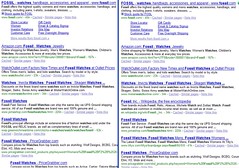
In the example screen-grab above, you’ll see that the lower-case search for “fossil watches” on the left side, has the site “jomashop.com” in the fifth position while a Wikipedia article is in the fifth position on the righthand example search in upper-case for “Fossil Watches”.
In another example search for “Chicago Hotels”, hotels.com and marriott.com trade out for the fourth position in the natural search results below the local one-box, with uppercase “Chicago Hotels” on the left and lowercase “chicago hotels” on the right:
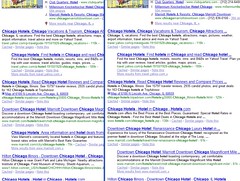
Searching for “Chicago hotels” seems to result in the same rankings as the all lower-case query.
As Search Engine Roundtable mentions, Google states that their search results are not case-sensitive:
Google searches are NOT case sensitive. All letters, regardless of how you type them, will be understood as lower case. For example, searches for george washington, George Washington, and gEoRgE wAsHiNgToN will all return the same results.
I now get different results in the 8th position for “george washington” vs. “George Washington” vs. “gEoRgE wAsHiNgToN”, when I expand out the number of listings per page in my preferences.
I was inclined to think that this might be an error due to the recent “Update Dewey” algorithm change that Matt Cutt requested feedback upon, so I reported it to Google, but have not heard back from them.
If this continues much longer, I think that SEOs will likely start doing all sorts of case-sensitive keyword research and optimization based off of it.
Possible Related Posts
Posted by Chris of Silvery on 04/15/2008
Permalink | |  Print
| Trackback | Comments Off on Travel Searches, Local & More Searches Turning Case-Sensitive in Google SERPs | Comments RSS
Print
| Trackback | Comments Off on Travel Searches, Local & More Searches Turning Case-Sensitive in Google SERPs | Comments RSS
Filed under: Google, Local Search, Local Search Optimization, Search Engine Optimization, Searching, SEO case sensitive, case sensitivity, Google, Keyword-Rankings, search engine results pages, SEO, SERPs


No comments for Travel Searches, Local & More Searches Turning Case-Sensitive in Google SERPs
No comments yet.
Sorry, the comment form is closed at this time.