WSJ Comments On Idearc Bankruptcy & Verizon Culpability
 A few days ago, the Wall Street Journal’s Dennis Berman commented in his column entitled “The Two Sides of Verizon’s Deal Making” on whether Verizon might have some responsibility for the bankruptcies of Idearc, Hawaiian Telecom and FairPoint Communications. As you may recall, I posted an op-ed piece on the subject, Idearc’s Bankruptcy – Who’s Really Responsible? at Search Engine Land not long back, and now Berman’s take on the issue appears to hold a lot of sympathy for my position that Verizon caused the yellow pages company to fail shortly after it was spun off by requiring it to do so with an unreasonably high debt load.
Berman states that while the market in 2006 may’ve allowed Verizon to take billions in the deal divesting itself of its directories corporation, Idearc, he further states:
“It took too much.”
Will there be any consequences for Verizon’s throwing off these companies with unserviceably high debt loads? Burman reports:
“These things matter greatly to how state and federal regulators perceive the company. Maine, New Hampshire, Vermont and Hawaii each are in an uproar over the FairPoint divestiture, with much of the ire directed at Verizon.”
In a brief video piece, David Berman debates the issue with Evan Newmark, who takes the opposite viewpoint that Verizon should not be held responsible for the performance of its divested companies. (more…)
Possible Related Posts
Posted by Chris of Silvery on 08/18/2009
Permalink | |  Print
| Trackback | Comments (0) | Comments RSS
Print
| Trackback | Comments (0) | Comments RSS
Filed under: General, Market Data, Worst Practices, Yellow Pages bankruptcies, bankruptcy, divestments, FairPoint Communications, FairPoint Communications Bankruptcy, Hawaiian Telecom, Hawaiian Telecom Bankruptcy, idearc, idearc bankruptcy, M&A, mergers and acquisitions, spinoffs, Verizon
Is Verizon Responsible for Idearc’s Bankruptcy?
 My op-ed piece, “Idearc’s Chapter 11 Bankruptcy: Who’s Really Responsible?” published today on Search Engine Land, and in it I put forth my position that Verizon is responsible for spinning off the company with an unreasonably huge debt load, and the people ultimately paying the bill are the stockholders.
I describe in the article how Verizon spun off Idearc Media (division which publishes print phone books and operates Superpages.com among other online yellow pages), and set that company up to pay back some billions of dollars for its worth. Verizon then turned around and resold those debt instruments to other companies, fully divesting itself of ownership in the new, standalone company.
This sequence in of itself isn’t remarkable – it’s the normal process a company might go through when spinning-off part of itself to form a new company.
But, my contention is that it was done so in a highly irresponsible manner. Verizon had to know beforehand that print directory business was going into shrinkage mode, and that the debt repayment structure would simply be too much for the new company to be reasonably expected to be able to handle. If so, then this could be expected to be a form of fraudulent conveyance, and Verizon could be culpable.
Is my contention outrageous?
Well, even Idearc’s Chief Executive, Scott Klein, has been paraphrased by the Wall Street Journal as saying “Everyone was aware that ‘$9 billion was really more debt than this business could bear'”. So, Idearc was spun off with a majority of this debt from Verizon from the start – clearly set up to fail.
So far, I’ve seen maybe three different law firms filing class-action lawsuits against Idearc and its executives, based on the premise that the stock tanked due to them secretly changing policies, resulting in inflated-looking sales on the books for businesses with higher likelihoods of not paying for contracted advertising. But, I think the real culprit in all this is likely Verizon – they pushed off a part of the company with an untenable debt load, in large part to pay off debts incurred by Verizon FiOS (Verizon’s fiber optic network) expansion.
Possible Related Posts
Posted by Chris of Silvery on 06/22/2009
Permalink | | Print
| Trackback | Comments (0) | Comments RSS
Filed under: General, Local Search, Market Data, News, Online Directories, Yellow Pages bankruptcy, chapter 11, directories, idearc, idearc bankruptcy, idearc chapter 11, Idearc-Media, iyp, Phone-Books, superpages, telco, telecomm, Verizon, Yellow Pages
New Print Yellow Pages Usage Stats from comScore-TMP Study
 TMP Directional Marketing and comScore announced their annual joint “Local Search Usage Study” today, and there were some interesting statistics:
- Following online local searches, consumers most often contact a business over the telephone (39%), visit the business in-person (32%) or contact the business online (12%).
- 1 out of 5 local business searchers with an Internet-accessible cell phone have conducted a local search via the mobile Web.
- Those that own wifi devices (such as the iPhone) are the most likely to conduct local business search via the mobile Web, with more than half of these respondents reporting mobile local business searching.
- 30 percent of respondents still rely on directories as their primary local business research source, despite a 3 percent decline from 2007 to 2008.
- Traditional IYP sites such as Superpages.com, YELLOWPAGES.COM, Yahoo! Yellowpages.com, etc. account for 60 percent of local IYP business searches.
- Local Search sites such as Google Maps, MapQuest, Yahoo! Local, etc. account for 40 percent of local IYP business searches. (more…)
Possible Related Posts
Posted by Chris of Silvery on 10/09/2008
Permalink | | Print
| Trackback | Comments (0) | Comments RSS
Filed under: Local Search, Market Data, Yellow Pages Phone-Books, print-yellow-pages, yellow pages usage, YP
Print Yellow Pages Usage On Decline Or Not?
 My article on how the “Yellow Pages Usage Stats Are Likely Wrong” went up earlier at Search Engine Land, and the details I highlight in it provide some strong circumstantial evidence that this year’s earlier industry statistics stating that print YP book usage hadn’t dropped over the year previous are likely incorrect.
As I point out, those statistics were all based on telephone polling, and those polls missed having representative samples of cell phone only households, according to their published methodology. Various research groups and government agencies have been saying that this is a significant chunk of the population — anywhere from 13.6%, growing to as much as 25% by the end of this year. (more…)
Possible Related Posts
Posted by Chris of Silvery on 07/29/2008
Permalink | | Print
| Trackback | Comments (0) | Comments RSS
Filed under: Advertising, Local Search, Market Data, Yellow Pages cell phone usage, polling, polls, Yellow Pages, YP
Internet Retailers Finding Growth During The Recession
I earlier wrote about how businesses could take advantage of a recession by swooping in to grab up some marketshare from more fearful businesses who might choose to cut back advertising and expansion during an uncertain period. Now Forrester Research and Shop.org have released some survey results indicating that many online merchants are seeing growth while brick-and-mortar businesses are experiencing reduced sales.
The one cautionary note a Forrester analyst added to the release was that many retailers are apparently planning to advertise more in social networking sites like MySpace and Facebook, even though it’s “still unproven how such sites might build direct revenue for retailers” (paraphrased).
I’d note that many of us in internet marketing have identified fairly significant promotional potential in social media sites, and that some degrees of integration with them are possible in many cases without incurring advertising costs — so, it may be that judicious campaigns should still be attempted, even if there is not a lot of research evidence indicating good ROI. Just as with any promotional campaigns, it’s important to try to measure results as you go, and adjust as indicated.
Possible Related Posts
Posted by Chris of Silvery on 04/08/2008
Permalink | | Print
| Trackback | Comments Off on Internet Retailers Finding Growth During The Recession | Comments RSS
Filed under: General, Market Data, Social Media Optimization economy, internet retail, online retail, Recession
Google Sending More Traffic To Google Maps
The New York Times today reported on a recent Hitwise post by Heather Hopkins highlighting that Google was now sending about three times as many of their users over to Google Maps comparing a week ending January 6th with a year ago.
This is apparently due in part to Google recommending Google Maps instead of recommending other mapping providers in addition as it had been doing early last year. (more…)
Possible Related Posts
Posted by Chris of Silvery on 01/14/2008
Permalink | | Print
| Trackback | Comments Off on Google Sending More Traffic To Google Maps | Comments RSS
Filed under: Google, Local Search, Maps, Market Data Google-Maps, Local Search, Mapquest
The Kelsey Group Puts Print Yellow Pages On Notice
Over at Media Post, The Kelsey Group is quoted today saying that the erosion in usage of print yellow pages is likely to fall off at a higher rate this year — by 10% this year, compared with only 2% to 3% erosion in recent years.
They state that a combination of factors such as more users going to internet yellow pages and local search engines combined with a recession are propelling the rapid erosion. Concerningly, one can extrapolate that if print YP usage is dropping, advertiser dollars might also follow the herd.
As Greg Sterling points out, The Kelsey Group has historically been a very staunch defender of the print YP industry, so this article is a bit of a gut-punch to people in the legacy print business, even though anyone watching the trends over the last few years won’t find it all that surprising.
One thing the Media Post article doesn’t mention is how (more…)
Possible Related Posts
Posted by Chris of Silvery on 01/11/2008
Permalink | | Print
| Trackback | Comments Off on The Kelsey Group Puts Print Yellow Pages On Notice | Comments RSS
Filed under: Local Search, Market Data, News, Yellow Pages iyp, Kelsey Group, Local Search, Online-Yellow-Pages, print-yellow-pages, Yellow Pages
Superpages.com Adds More User-Generated Content to the Local Mix
About a week ago, Idearc announced that Superpages.com had introduced more user-content features.
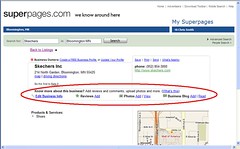
Previously, the primary component of user content on the site was limited to user ratings and reviews associated with business listings.
Some of the new features this recent upgrade added include allowing all users to enhance basic biz profile information, uploading pictures of organizations, wiki-like biz listing “blog” features which could allow simplistic blogging by businesses and/or could be used as a consumer comment or Q/A zone for each business since any user could submit info to them.
Of all the top online yellow pages and local search sites, I believe that Superpages may now have the distinction of having the greatest (more…)
Possible Related Posts
Posted by stephan of stephan on 11/14/2007
Permalink | | Print
| Trackback | Comments Off on Superpages.com Adds More User-Generated Content to the Local Mix | Comments RSS
Filed under: Design, Local Search, Market Data, News, Online Directories, Social Media Optimization, Yellow Pages idearc, Internet-Yellow-Pages, iyp, Local Search, superpages, Yellow Pages
Is InfoSpace Cashing Out?
First it was announced that InfoSpace was selling Switchboard and other directory properties of theirs to Idearc for $225 million. Today InfoSpace announces that they’re selling off their mobile services business for $135 million.

InfoSpace’s release says that they’re selling off the mobile services “…to focus on online search”. They’re apparently going to also give a chunk of this change back to their shareholders in a dividend.
This just makes me wonder, is Infospace cashing out?
Local search has been one of Infospace’s strengths over time — they even changed their core website a few years ago to focus on local search & yellow pages more — prior to that they’d been a more general search engine (they still own general meta search engines like Dogpile.com).
Also, this mobile service sale seems odd since the rest of the internet marketing industry is starting to hyper-focus on mobile search and services.
Even though “yellow pages” directories are not exactly the same thing as local search, you’d expect for InfoSpace to hold onto the assets (and hold onto the mobile services), or to sell the assets to use the money to capitalize on the search areas where they want to focus. So, why are they doing this?
Possible Related Posts
Posted by Chris of Silvery on 10/15/2007
Permalink | | Print
| Trackback | Comments Off on Is InfoSpace Cashing Out? | Comments RSS
Filed under: Local Search, Market Data, News InfoSpace, Local Search, Mobile Search
Am I an SEO Dog? More On Toasting of Internet Yellow Pages
Donna Bogatin apparently disagreed with my article at SEL entitled “Google Trends: Yellow Pages Will Be Toast in Four Years“, posting a bit of a lurid headline herself: “Yellow Pages Trash Talking: The SEO Dog in the Google Local Fight“.
I didn’t really think that my article was quite “trash talk“, and I’m assuming from the article content that the “SEO Dog” referred to was perhaps myself, or perhaps the “dog” is my article conclusions, fighting for the ostensibly narrow viewpoint of all SEOs. Aside from the somewhat scathing disembowelment attempted, I thought it’d be informative for me to address some of the logic-faulty conclusions that were drawn.
Possible Related Posts
Posted by Chris of Silvery on 09/25/2007
Permalink | | Print
| Trackback | Comments Off on Am I an SEO Dog? More On Toasting of Internet Yellow Pages | Comments RSS
Filed under: Local Search, Market Data, Online Directories, Yellow Pages Donna-Bogatin, iyp, Local Search Optimization, local-SEO, Online-Yellow-Pages, Search-Engine-Land, SEO, Yellow Pages

